
Rising Medigap Loss Ratios Demand Faster Leakage Detection
When claims pressure keeps rising in Medicare Supplement Insurance (Medigap), pricing is only part of the response. Payers need earlier visibility into leakage, faster correction cycles, and tighter workflow discipline across eligibility, claims, premium, and recovery.
By Editorial Desk
Key Takeaways
- →Medigap claims and loss ratios are rising, and many payers are already responding with rate action.
- →Pricing helps late. Faster leakage detection helps earlier by reducing avoidable cost before it gets embedded in the block.
- →Better visibility across eligibility, claims, premium, and recovery can improve financial control, workflow discipline, and member and provider experience.
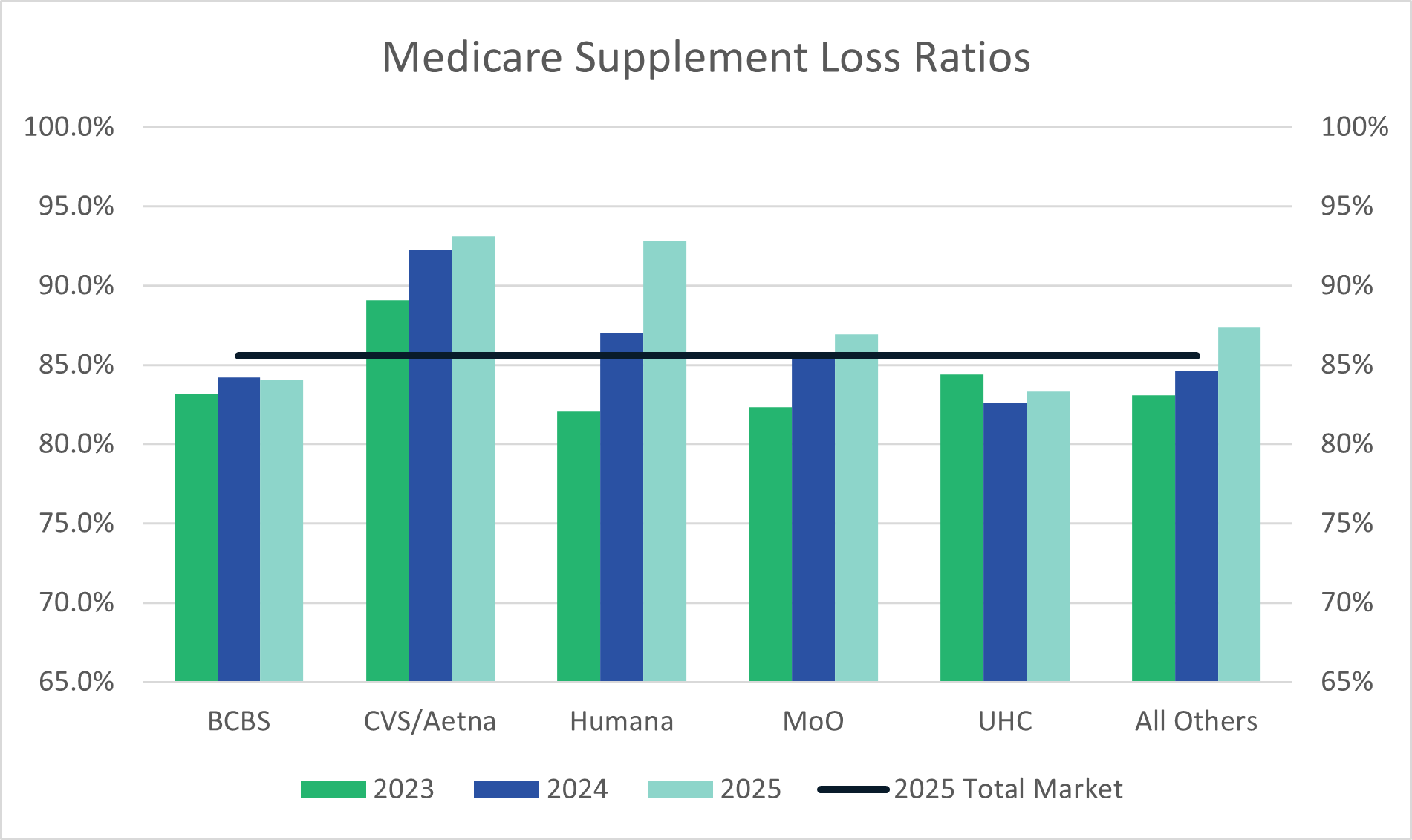
A recent Medicare Market Insights update put useful numbers around a problem many Medigap leaders are already seeing in block performance, pricing reviews, and renewal planning. According to the March 2026 update, earned premium in the Medigap market increased from $37.6 billion in 2024 to $39.9 billion in 2025, while incurred claims rose from $31.7 billion to $34.1 billion. The same update reported a 2025 total-market loss ratio of 85.6% and noted that early 2026 results are already showing more higher-than-medical-trend rate increases as payers try to bring loss ratios back toward pricing targets.
That matters for a simple reason. When claim expense keeps rising alongside premium, payers eventually run out of room to treat the issue as a pricing discussion alone. Rate action may help protect the block over time, but it does not fix the operating conditions that allowed avoidable loss to build in the first place. It also does little to reduce the administrative burden that spreads across finance, claims, provider relations, and member service once the problem is already embedded in the workflow.
The two charts attached to this article help frame the issue more clearly.
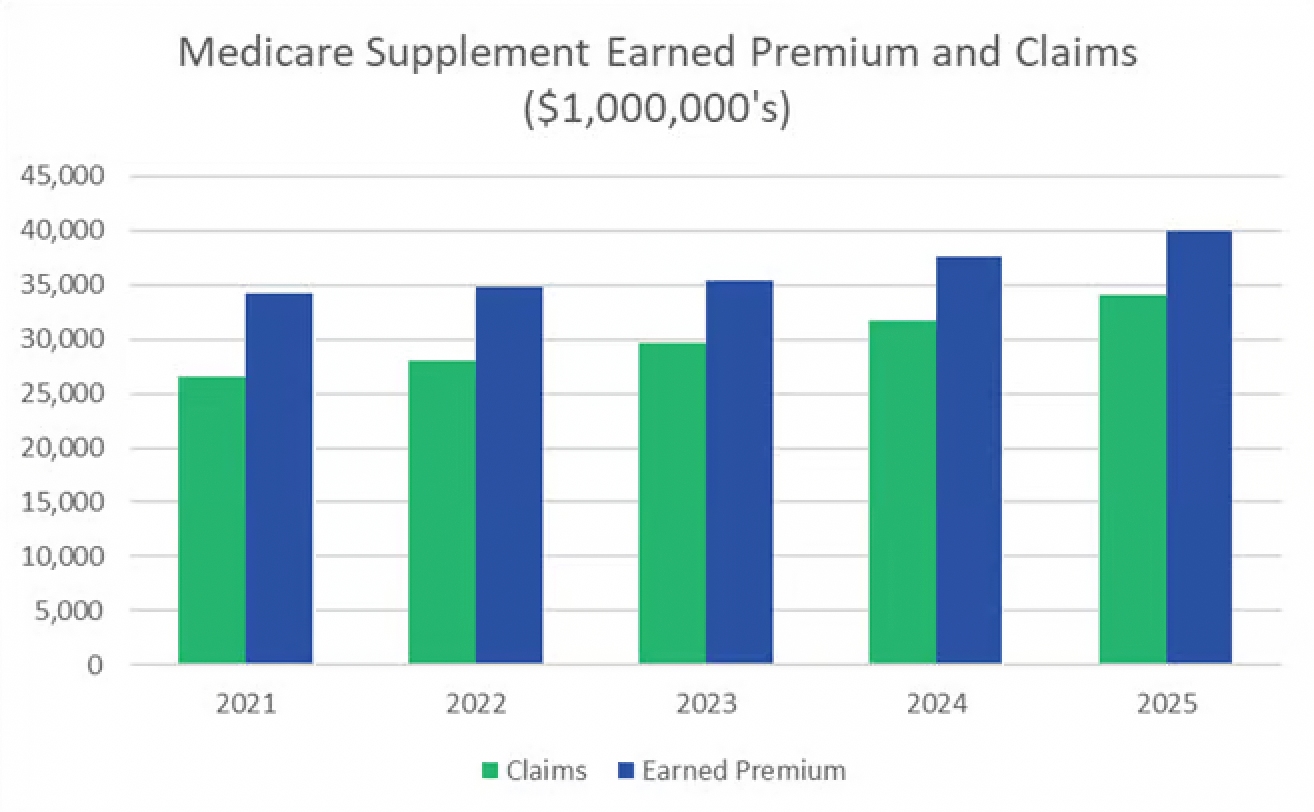
The first, Medicare Supplement Earned Premium and Claims, shows the market growing on both sides of the ledger. Premium is rising. Claims are rising with it. That pattern should push leadership toward a more practical question: where are the controllable dollars getting lost before the next filing cycle turns those losses into another round of higher rates?
The second, Medicare Supplement Loss Ratios, shows something just as important. The pressure is not uniform. Some payer groups are running well above the 2025 total-market line, while others are closer to it or below it. No serious operator would look at that spread and assume there is a single explanation. Loss ratios reflect real differences in morbidity, geography, product mix, block maturity, and member behavior. Even so, variation of that size usually means the market story is only one part of the story. There is often an operating story underneath it.
What the latest Medigap data is really showing
The Medicare Market Insights update is useful because it puts real numbers behind a trend that many teams are already feeling. Claims are rising fast enough to put pressure on loss ratios. Payers are responding with higher rate actions, including actions that appear to be running above basic medical trend in early 2026 experience.
That should get attention, but the more important takeaway is not simply that claims are rising. The more important takeaway is that elevated loss-ratio pressure creates urgency around the few levers leadership can still control in real time.
One of those levers is faster leakage detection.
Why rising loss ratios are also an operating problem
In Medigap, a meaningful share of financial strain does not begin as an actuarial problem. It begins as a workflow problem.
It starts when eligibility, premium, claims, recovery, and reporting sit in separate systems with separate owners and different reporting cycles. It starts when one team sees part of the issue but not the whole issue. It starts when payment exceptions are found too late to meaningfully change the current financial outcome.
That is where leakage becomes important.
Leakage does not need to mean fraud to be expensive. It can show up in eligibility mismatches, duplicate payments, coordination errors, retroactive enrollment changes, delayed recovery workflows, and weak exception management. None of those issues need to be large on their own. At scale, they become expensive quickly.
Medicare's coordination guidance makes the logic clear. The primary payer pays first, and the secondary payer pays only for eligible remaining amounts. Medicare also states that accurate coordination helps bills reach the right payer in the right order and helps avoid delays.
CMS claims-processing guidance reinforces the point from the payment side. Medicare claims systems include edits to identify exact duplicate claims and suspect duplicate claims for denial, rejection, or review. That reflects a simple operating truth: payment accuracy depends on disciplined coordination, accurate data handling, and timely exception management.
That does not mean every elevated loss ratio is caused by leakage. It does mean that in a market built on payment coordination and secondary-payer accuracy, avoidable leakage can meaningfully worsen already-tight economics.
VHealth helps payers improve financial visibility across eligibility, claims, premium, and recovery, with compliance-centered workflow discipline built in. Explore our advisory areas.
Where leakage shows up in payer workflows
The most expensive operating problems are often the least dramatic. They hide in routine handoffs and manual work.
A payer may have an eligibility mismatch that is not caught early enough. A retroactive change may not flow through every downstream workflow fast enough. A duplicate payment may be identified eventually but not soon enough to help the current reporting period. A coordination issue may sit between systems long enough to create unnecessary claims cost, recovery effort, and provider abrasion.
By the time these issues surface in a quarterly financial review, the best window to prevent damage may already be gone.
That is why the spread in the loss-ratio chart matters. If every payer were clustered tightly around the same result, the room for operational differentiation would look narrower. That is not what the chart shows. It shows variation. Variation usually points to a mix of external pressure and internal control. Leadership teams should want to know how much of current pressure reflects unavoidable trend and how much reflects leakage that could have been identified and addressed earlier.
What payers should do next
There are three practical moves that stand out.
1. Build a unified financial and operational view
Eligibility, premium, claims, and recovery should not live in separate reporting worlds. Better financial visibility in healthcare operations across the full chain helps teams identify where money is leaking, why it is happening, and which workflow needs attention first.
2. Tighten review around common leakage categories
Duplicate payments, coordination errors, retroactive changes, and mismatched records should move through a faster exception cycle. This is an area where human-controlled artificial intelligence (AI) can help. AI-supported operations can surface anomalies earlier across fragmented data and reduce manual triage, but accountable human review still has to govern final action.
3. Measure speed to correction, not only dollars recovered
Recovery volume matters, but timing matters just as much. Dollars found six months later do not protect the current period the same way dollars found near the point of payment do. Faster correction supports margin protection, cleaner pricing decisions, and less avoidable rework across operations.
Why this matters beyond finance
When internal payment and reconciliation workflows are slow or inconsistent, the burden spreads outward.
Providers deal with more follow-up, more friction, and slower resolution. Members experience more confusion and less clarity. Internal teams absorb more manual work than they should. Trust weakens when the system cannot explain its own financial behavior cleanly.
That is why rising Medigap loss ratios deserve an operating response, not only a pricing response.
The stronger leadership question is straightforward: how much of current loss-ratio pressure is truly uncontrollable, and how much reflects leakage that could have been identified, routed, and corrected earlier?
Payers will not control every source of claim trend. They can control how quickly they see problems, how clearly they understand them, and how consistently they act before those problems harden into the next round of rates. Earlier detection creates better options. In this market, that is what better payer workflow discipline looks like.
Frequently asked questions
Why are Medigap loss ratios rising?
Medigap loss ratios are rising because incurred claims are increasing faster and putting more pressure on block economics. Medicare Market Insights reported that earned premium rose from $37.6 billion in 2024 to $39.9 billion in 2025, while incurred claims rose from $31.7 billion to $34.1 billion.
Can payers reduce Medigap loss ratios without relying only on rate increases?
Payers cannot remove all claims trend, but they can reduce avoidable loss through earlier leakage detection, tighter workflow controls, faster exception management, and better visibility across eligibility, claims, premium, and recovery.
What is claims leakage in Medigap?
In this context, claims leakage can include duplicate payments, coordination errors, eligibility mismatches, retroactive enrollment changes, and delayed recovery action. These are operating failures that can create unnecessary cost when they are found too late.
Why does financial visibility matter in Medigap performance?
Financial visibility matters because the root cause of claim cost is often hidden across fragmented systems. When eligibility, payment, recovery, and reporting are disconnected, teams find issues later and correct them more slowly.
How can human-controlled artificial intelligence support this work?
Human-controlled artificial intelligence can help surface anomalies earlier, reduce manual triage, and support faster routing of exceptions. It works best when paired with accountable human review, clear governance, and defined workflow ownership.

Farzin Espahani
Principal Consultant, VHealth
Farzin Espahani is a Strategic Advisor focused on insurance growth, Medicare distribution, healthcare operations, and compliance-aware performance marketing.
He has led growth, marketplace operations, partner distribution, and Medicare marketing initiatives across regulated healthcare and insurance markets, with experience spanning QuinStreet, Health IQ, Solution21, and The Patient's Guide, which was acquired by IAC Publishing.
At QuinStreet, he worked across Medicare and health insurance distribution, performance marketing, partner economics, lead quality, compliance alignment, funnel performance, and AI-enabled consumer decision support, including the development of an AI-powered Medicare plan recommendation experience for Insure.com.
Farzin also serves in industry leadership and advisory roles with the Insurance Marketing Coalition and Lead Quality Alliance, where his work supports ethical marketing, lead quality, consumer transparency, and compliance-aware growth.
His academic background in biocultural anthropology, sociology, and social psychology informs how he evaluates consumer behavior, incentives, trust, decision-making, and organizational friction. His executive education includes programs at Massachusetts Institute of Technology (MIT) Sloan, Wharton, Cornell, and Northwestern Kellogg, with advanced study in artificial intelligence (AI), revenue analytics, pricing, leadership, change management, and communication.
For VHealth, Farzin brings a practical advisory lens on healthcare growth, workflow visibility, regulated distribution, compliance-aware interpretation, and responsible AI-enabled decision support.
Related reading
Advisory for Payers
Financial visibility, claims leakage detection, and payer workflow discipline
Advisory Areas
How VHealth structures advisory work across healthcare operations
Advisory for Providers
Audit readiness, defensibility, and operational performance for providers
Schedule a Conversation
Discuss financial visibility and leakage detection for your organization
Need faster leakage detection and better financial visibility?
VHealth helps payers improve visibility across eligibility, claims, premium, and recovery with compliance-centered workflow discipline.
Get new VHealth insights in your inbox
Operations, compliance, AI implementation. No noise.
Admin — Notify Subscribers
Enter admin password to send notifications.