
Modular Intelligence Solutions for Healthcare Operations
Healthcare organizations do not need more dashboards. They need clearer visibility, faster decisions, and stronger compliance across the workflows that drive cost, revenue, utilization, workforce performance, and operational execution.
Key Takeaways
- →Healthcare organizations do not need more dashboards, they need connected workflow decision support across cost, revenue, utilization, workforce, and growth.
- →A modular approach lets leaders start with one high-friction area, prove value, and expand without forcing a full enterprise overhaul on day one.
- →Compliance must be built into the workflow itself, not added after the fact, to keep decision support defensible in a regulated environment.
- →The strongest solutions are not the most technical ones. They are the ones that help teams reduce friction, improve visibility, and act with greater accountability.
That is where modular intelligence solutions for healthcare operations can help.
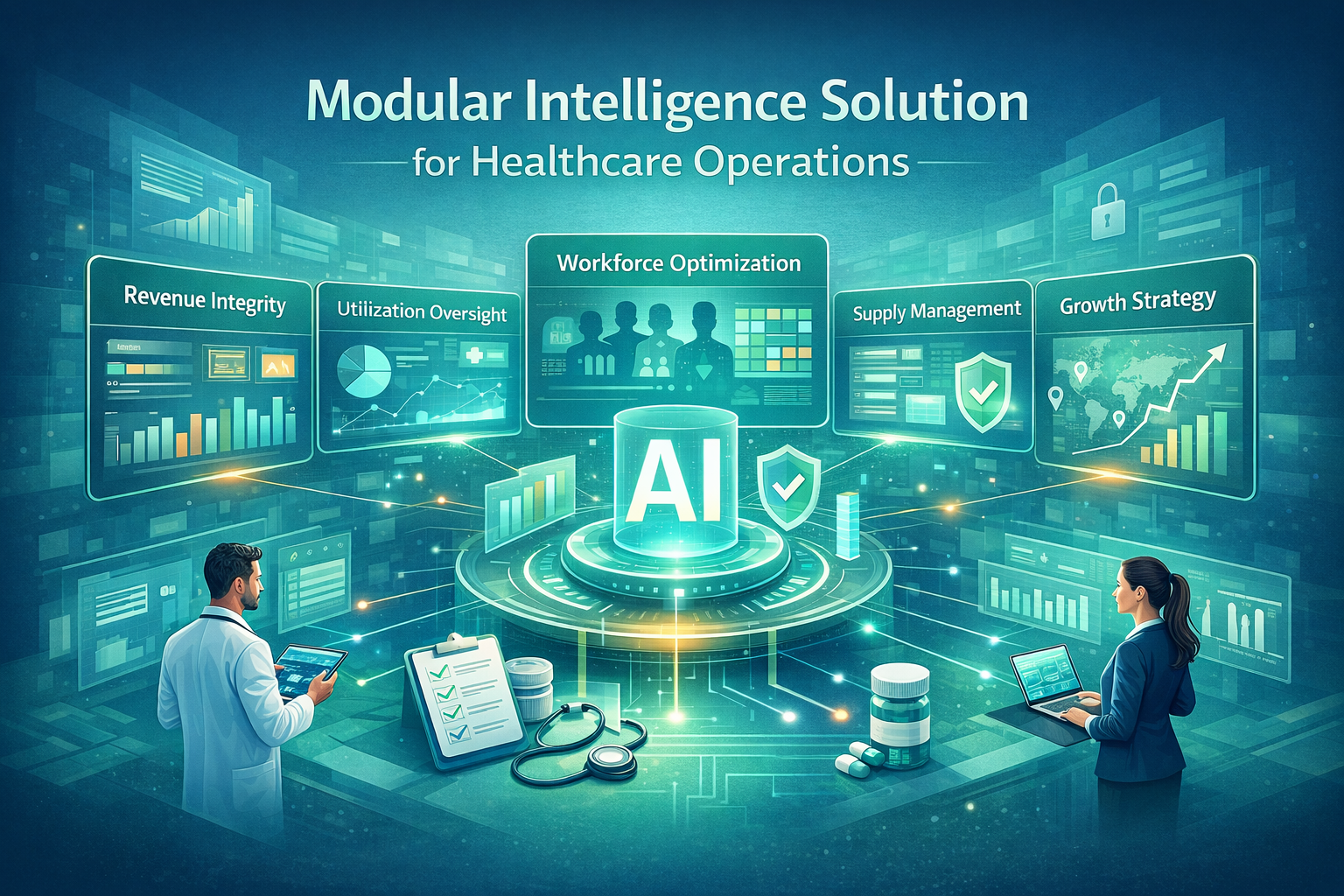
In simple terms, a modular intelligence solution helps healthcare organizations turn scattered operational and financial data into clearer decisions across revenue, utilization, workforce, supply, and growth workflows, with compliance and human accountability built into the process.
For leaders who are not deeply technical, that is the most important place to start. This is not mainly about artificial intelligence for its own sake. It is about helping healthcare teams see what matters sooner, understand what needs attention, and move with more confidence inside highly regulated environments.
What Modular Intelligence Solutions Mean in Healthcare
A modular intelligence solution is a compliance-first decision support approach built on a shared data and analytics foundation. Instead of trying to solve every enterprise problem at once, it applies focused operational intelligence to specific business areas such as revenue integrity, utilization oversight, workforce planning, supply visibility, and growth strategy.
The word modular matters because healthcare organizations rarely have one isolated problem. A hospital may be facing denial pressure, labor strain, rising supply costs, and referral leakage at the same time. A health plan may be focused on utilization, documentation, coding accuracy, medical expense, and provider performance. A risk-bearing organization may need better visibility into reimbursement, operational efficiency, and patient flow all at once.
A modular approach allows leaders to start where the business friction is greatest, prove value, and expand over time without forcing a full enterprise overhaul on day one.
The word intelligence also deserves a plain-English explanation. In healthcare operations, intelligence means turning disconnected data into practical insight that helps teams prioritize, investigate, and act. It is not about replacing human judgment. It is about giving operators, finance leaders, care managers, commercial teams, and executives a clearer view of what is happening and where decisions should begin.
Why Healthcare Operations Need a Modular Approach
Healthcare already generates enormous amounts of data, but that does not always create clarity.
Most organizations have reporting tools, finance systems, spreadsheets, claims data, staffing reports, operational dashboards, and teams working hard to interpret them. The challenge is that these signals often live in separate places, are reviewed by different teams, and do not always connect into one coherent operating picture.
That fragmentation creates real business problems.
Revenue issues get discovered late. Utilization patterns may not be reviewed quickly enough. Staffing decisions can become reactive instead of planned. Supply costs may rise without a clear line of sight into service-line economics. Growth teams may know they want more volume, but not have a precise view of where referral patterns are strengthening, weakening, or drifting.
This is why modular healthcare operations intelligence matters. It helps organizations move from disconnected reporting to more connected workflow decision support.
The broader healthcare environment makes this even more urgent. Hospitals and health systems continue to face administrative burden, reimbursement pressure, elevated labor costs, and rising supply expense, while prior authorization and claims complexity continue to consume time and operational resources. The American Hospital Association has also pointed to high claims administration costs and persistent financial strain across the provider landscape.
What Modular Intelligence Solutions Can Help Teams Do
A modular intelligence solution becomes easier to understand when you look at the specific workflows it can support.
Revenue Integrity and Financial Visibility
One of the clearest use cases is revenue integrity.
Healthcare organizations often lose time and margin because denial patterns, coding friction, documentation gaps, and payer behavior are not always visible in one place. A modular intelligence workflow can help teams see recurring patterns, prioritize high-value issues, and identify where preventable rework may be affecting revenue performance.
This does not mean a system replaces finance or revenue cycle judgment. It means the organization has a better way to identify which issues are noise and which ones deserve immediate attention.
For healthcare executives, this can support better visibility into margin pressure, avoidable administrative cost, and opportunities to improve decision speed across revenue-related workflows.
Utilization and Risk Oversight
Another major use case is utilization and risk oversight.
For health plans, accountable care organizations (ACOs), independent physician associations (IPAs), management services organizations (MSOs), and other risk-bearing entities, the challenge is rarely a lack of data. The challenge is connecting that data into usable operational insight.
A modular intelligence solution can help teams review utilization trends, referral behavior, cost drivers, documentation patterns, reimbursement exposure, and areas of administrative friction more clearly. It can support earlier identification of issues that may affect medical expense, workflow efficiency, or operational accountability.
That matters even more in today's environment, where concerns about artificial intelligence in utilization management and prior authorization have become more visible. The American Medical Association reported that 61 percent of physicians feared unregulated artificial intelligence was increasing prior authorization denials, reinforcing the need for compliance-first workflow design and human review.
Workforce Planning and Operational Efficiency
Workforce pressure remains one of the most practical reasons healthcare organizations need better decision support.
A modular workforce intelligence workflow can help leaders connect staffing levels, productivity, utilization, operational demand, and financial performance into a more usable view. That helps organizations make better decisions about deployment, capacity, and workflow design rather than relying only on reactive staffing responses.
For executives, this is not just about labor reduction. It is about understanding whether the organization is using talent effectively, whether teams are working at the right level, and where operational strain is building before it becomes a larger cost or service issue.
The American Hospital Association has described the healthcare workforce system as remaining under significant pressure, shaped by labor shortages, burnout, and long-term structural change.
Supply and Cost Visibility
Supply expense is another area where fragmented data can hide important signals.
In many organizations, supply decisions, utilization data, and financial performance are reviewed in separate systems by separate teams. That makes it harder to understand where variation exists, where unnecessary expense is accumulating, and how supply use connects to service-line performance.
A modular intelligence workflow can help leaders link supply data more closely to operational and financial outcomes. This can support better visibility into variation, exceptions, and opportunities to improve decision-making around cost control without disrupting the underlying workflow.
For healthcare leaders, this is often where operational intelligence becomes very concrete. It is no longer an abstract conversation about analytics. It becomes a clearer view of what is being used, what it is costing, and how that connects to business performance.
Growth, Referrals, and Demand Planning
Marketers, sales leaders, and strategy executives should care about modular intelligence solutions too.
Healthcare growth is not just a marketing problem. It is also an operational visibility problem.
A modular demand intelligence workflow can help organizations understand feeder networks, service-line opportunity, catchment performance, referral patterns, and local demand dynamics. This can support more informed decisions about where growth opportunities exist and where operational friction may be limiting performance.
For commercial teams, that means better alignment between growth strategy and real operational conditions. Instead of guessing where opportunity may exist, leaders can use a more grounded view of demand, network behavior, and market movement.
That is especially valuable in healthcare because commercial success depends on more than lead generation. It depends on network relationships, access, capacity, workflow readiness, and operational follow-through.
Why Compliance Has to Be Built Into the Workflow
In healthcare, compliance cannot be a side note.
Any solution that touches operational decision-making, patient-related workflows, financial performance, utilization review, or workforce data must be designed with compliance at the center. That includes data governance, access control, privacy discipline, explainability, process accountability, and human review.
This is one of the most important points for non-technical leaders to understand.
A healthcare intelligence solution should not simply produce signals faster. It should help the organization act more responsibly. If a workflow becomes faster but less defensible, that is not meaningful progress. If a recommendation cannot be reviewed, explained, or governed, it introduces risk instead of reducing friction.
Compliance-first workflow design means the solution supports better decision-making without losing discipline around how data is used, who can access it, how outputs are reviewed, and how actions are documented. In a regulated environment, that is not optional. It is central to trust.
How Healthcare Leaders Should Evaluate a Modular Intelligence Solution
Healthcare leaders do not need to become technical experts to evaluate these solutions well. They need to ask practical questions.
Does the solution help solve a real operational problem, or is it mainly a reporting layer with polished language?
Can the organization start with one business priority and expand over time, or does the solution require a full-scale transformation before value can be seen?
Does it support decision-making across revenue, utilization, workforce, supply, or growth workflows in a way that operators can actually use?
Is compliance built into the workflow itself through governance, visibility, accountability, and human review?
Can leaders understand why a signal matters, what team should act, and how the outcome will be measured?
Those questions matter because the strongest healthcare intelligence solutions are not the ones that sound the most technical. They are the ones that help teams reduce friction, improve visibility, and support better decisions inside the reality of healthcare operations.
Why This Matters Now
Healthcare organizations are under pressure to improve performance without adding more fragmentation.
They need ways to identify avoidable cost drivers earlier. They need stronger visibility across operational and financial workflows. They need decision support that helps people move faster without sacrificing accountability. And they need solutions that respect the complexity of healthcare rather than pretending one system can solve everything at once.
That is why modular intelligence solutions for healthcare operations are getting attention.
They offer a more practical model for adoption. Teams can start with a specific problem, build confidence, improve a workflow, and expand from there. When done well, this approach can support better decision speed, clearer operational insight, stronger compliance, and more aligned execution across the enterprise.
For healthcare marketers, sales leaders, and executives who are not artificial intelligence specialists, that is the core takeaway.
This category is not mainly about machine learning terminology or technical architecture. It is about whether an organization can turn scattered data into responsible action across the workflows that affect cost, utilization, revenue, growth, and operational performance.
Frequently Asked Questions About Modular Intelligence Solutions
What is a modular intelligence solution in healthcare?
A modular intelligence solution is a healthcare decision support approach built on a shared data and analytics foundation, then applied to specific operational workflows such as revenue integrity, utilization oversight, workforce planning, supply management, and growth strategy.
Why does modular matter in healthcare operations?
Modular matters because healthcare organizations usually face multiple operational problems at once. A modular approach allows leaders to start with one priority area, prove value, and expand over time without requiring a full enterprise overhaul at the beginning.
How is this different from a standard dashboard?
A standard dashboard often shows what has already happened. A modular intelligence solution is designed to help teams identify patterns, prioritize issues, support action, and improve workflow decision-making with greater accountability.
Why is compliance so important in healthcare intelligence solutions?
Compliance matters because healthcare workflows involve sensitive data, regulated processes, and operational risk. A strong solution should support governance, privacy, access control, explainability, and human review as part of the workflow itself.
Who should care about modular intelligence solutions?
Payers, providers, health systems, accountable care organizations, finance leaders, operations teams, marketers, sales leaders, and executives responsible for cost, utilization, reimbursement, and growth strategy should all care about how these solutions are designed and governed.
Closing Section
Healthcare organizations do not need more noise. They need better visibility, stronger compliance, and decision support that helps teams act with greater clarity.
Modular intelligence solutions can help by connecting data, surfacing meaningful signals, and supporting more accountable action across healthcare operations.
That is the opportunity. Not technology for its own sake, but better workflow support for the people responsible for cost, utilization, revenue, workforce, and growth decisions every day.
Related reading
Advisory for Payers
Financial visibility, utilization oversight, and compliance-centered execution for health plans
Advisory for Providers
Revenue integrity, workflow discipline, and operational performance for provider organizations
Advisory Areas
How VHealth structures advisory work across healthcare operations
Schedule a Conversation
Discuss modular intelligence and operational visibility for your organization
Need better operational visibility across your healthcare workflows?
VHealth helps healthcare organizations improve decision support across cost, revenue, utilization, workforce, and growth, with compliance-centered execution built in.

Farzin Espahani
Principal Consultant, VHealth
Farzin Espahani is a Strategic Advisor focused on insurance growth, Medicare distribution, healthcare operations, and compliance-aware performance marketing.
He has led growth, marketplace operations, partner distribution, and Medicare marketing initiatives across regulated healthcare and insurance markets, with experience spanning QuinStreet, Health IQ, Solution21, and The Patient's Guide, which was acquired by IAC Publishing.
At QuinStreet, he worked across Medicare and health insurance distribution, performance marketing, partner economics, lead quality, compliance alignment, funnel performance, and AI-enabled consumer decision support, including the development of an AI-powered Medicare plan recommendation experience for Insure.com.
Farzin also serves in industry leadership and advisory roles with the Insurance Marketing Coalition and Lead Quality Alliance, where his work supports ethical marketing, lead quality, consumer transparency, and compliance-aware growth.
His academic background in biocultural anthropology, sociology, and social psychology informs how he evaluates consumer behavior, incentives, trust, decision-making, and organizational friction. His executive education includes programs at Massachusetts Institute of Technology (MIT) Sloan, Wharton, Cornell, and Northwestern Kellogg, with advanced study in artificial intelligence (AI), revenue analytics, pricing, leadership, change management, and communication.
For VHealth, Farzin brings a practical advisory lens on healthcare growth, workflow visibility, regulated distribution, compliance-aware interpretation, and responsible AI-enabled decision support.
Get new VHealth insights in your inbox
Operations, compliance, AI implementation. No noise.
Admin — Notify Subscribers
Enter admin password to send notifications.